Websites & Apps
SaaS Product Development
gaa-tha builds SaaS products for founders and businesses turning an idea or internal tool into software they sell: idea validation and MVP, multi-tenant architecture, authentication and roles, subscription billing with Stripe or Razorpay, admin and analytics, AI features, cloud and DevOps on AWS, Google Cloud, Vercel or Firebase, and security practices that stand up to customer reviews.
Last updated 22 October 2026
 Service hero · 16:9
- Best for
- Founders validating a SaaS idea, funded startups needing an MVP or a rebuilt v2, and established businesses productising an internal tool or their expertise
- Timeline
- Validation 2–4 weeks; MVP 10–16 weeks; continuous releases after launch
- Engagement model
- Fixed phases for validation and MVP, then a monthly product-team retainer
- Channels / platforms
- Web apps in Next.js and React, Node.js or Python APIs, PostgreSQL, AWS, Google Cloud, Vercel, Firebase and Supabase
The service
What is SaaS Product Development?
SaaS product development is the work of building software that many customers use on subscription: one codebase serving many separate accounts, called tenants, each with its own users, roles, data and billing plan, running reliably in the cloud and improving through frequent releases. Beyond features, a SaaS product needs sign-up and onboarding, billing and invoicing, an internal admin, usage analytics, security and room to scale without a rewrite.
At gaa-tha we treat the first months as a search for proof, not a build of everything. We test the problem with real buyers, ship the smallest product someone will pay for, and design the foundations — tenancy, data model, auth and billing — so the next hundred customers do not force a rebuild. For Indian founders selling abroad and international founders building with an Indian team, billing, tax and data-protection choices are made early, because they are expensive to change later.
Scope
What's included
- Idea validation — problem interviews, competitor and pricing research, landing-page and waitlist tests
- MVP scoping, user flows and UI design, with a design system that scales to later features
- Multi-tenant architecture: tenant isolation, data model, row-level security and per-tenant settings
- Authentication and authorisation — email, Google and SSO sign-in, organisations, roles and permissions
- Subscription billing with Stripe, Razorpay Subscriptions, Chargebee or Paddle — plans, trials, usage-based pricing, invoices and GST or VAT handling
- Internal admin console, customer-support tools and product analytics with PostHog or Mixpanel
- AI features using Claude, GPT or Gemini — search and answers over customer data, summaries, drafting and AI agents — with cost and safety controls
- Cloud infrastructure on AWS, Google Cloud, Vercel, Firebase or Supabase, with CI/CD, staging and infrastructure as code
- Security and privacy practices aligned with SOC 2, GDPR and India's DPDP Act — audit logs, encryption, backups and access reviews
- Monitoring, performance tuning and scaling as usage grows
Process
How we work
Five steps, in the order they happen.
Validate
We test the problem and the price with real prospects through interviews, a landing page and, where useful, a manual or no-code prototype, before any production code is written.
Scope and architect
The MVP is cut to the workflows that prove value, and tenancy, data model, auth, billing and cloud choices are made with the next two years in mind.
Design
Onboarding, core workflows, settings and billing screens are designed and prototyped so a first-time user reaches value in the first session.
Build and ship
The product is built in two-week sprints with automated tests, staging and CI/CD, and released to design partners before a public launch.
Measure and scale
Product analytics, support tickets and revenue data drive the roadmap, while security, performance and infrastructure are hardened as customers arrive.
Outputs
Deliverables you receive
- Validation report with interview notes, pricing hypothesis and MVP scope
- Architecture document covering tenancy, data model, auth, billing and cloud
- Figma designs and a product design system
- Live SaaS application with billing, admin console and analytics
- CI/CD pipeline, staging and production environments, monitoring and backups
- Source code, technical documentation and a security practices handbook, all in your accounts
Stack
Tools & platforms
Pricing model. Validation and MVP are quoted as fixed phases after a discovery call; ongoing development runs as a monthly product-team retainer, and cloud, billing and third-party API costs are paid by you directly.
Good to know
Questions about SaaS products
Answer-first, so humans and AI assistants get the point quickly.
The cost of a SaaS MVP depends on the number of core workflows, user roles and integrations, whether billing is simple plans or usage-based, how much AI is involved, and the level of security your buyers expect. A single-workflow tool for small businesses and an enterprise product with SSO and audit logs are very different builds. gaa-tha quotes validation and MVP as fixed phases after discovery, and our SaaS product development guide covers what moves the number.
A SaaS MVP typically takes ten to sixteen weeks to build after two to four weeks of validation and scoping. The fastest launches cut the first version to one workflow that a specific customer will pay for, then add the rest once real usage data arrives.
Our default SaaS stack is TypeScript end to end — Next.js or React on the front end, Node.js APIs and PostgreSQL — with Python where AI or data work is central, hosted on AWS, Google Cloud, Vercel or Supabase depending on scale and team. We pick well-supported, widely used tools so you can hire for them later, and document every choice.
Multi-tenant architecture means one application serves many customer organisations while keeping each one's data separate. Almost every SaaS product needs it; the real question is how strict the separation is — a shared database with tenant-level security for most products, or separate schemas or databases for customers with stricter requirements. Getting this right at the start avoids a painful migration later.
Indian SaaS companies commonly use Razorpay Subscriptions with UPI Autopay and card mandates for domestic customers, and Razorpay's international payments, Paddle as a merchant of record, or Stripe where their entity is eligible for overseas customers. The right setup depends on where your company is registered, where customers are and how much tax handling you want to outsource. Eligibility and RBI recurring-payment rules change, so we confirm current terms with each provider before wiring billing.
Compliance is something your company achieves through an audit or assessment, not something code alone provides, but we build with the practices those frameworks expect: access controls, encryption, audit logs, backups, retention rules, consent records and documented processes. That makes a SOC 2 audit, a GDPR review or India's Digital Personal Data Protection (DPDP) obligations far easier when customers start asking. We do not issue certifications; we prepare the product and the paperwork for your auditor.
Yes. We add AI where it saves users real time — answering questions over their own data, drafting, classification, summaries and agents that complete multi-step tasks — using Claude, GPT or Gemini models through their APIs. Each feature ships with usage limits, cost tracking, evaluation tests and tenant-level data separation, so AI does not become an uncontrolled bill or a data leak.
You own the code, the IP and every cloud and billing account from day one; the repository and infrastructure sit in your organisation. After launch most clients keep a monthly product-team retainer for releases, monitoring and scaling, while some move development in-house — the system is documented so that handover is straightforward.
Keep exploring
Related services
 Service card · 4:3
Web & Mobile App Design
UI/UX for apps, admin consoles and dashboards — clickable prototypes, then developer-ready systems.
Explore → Service card · 4:3
Mobile App Development
iOS and Android apps designed, built, published and maintained by one team — from the first screen to the store listing.
Explore → Service card · 4:3
Website Design & Development
Fast, accessible, search-ready sites built to turn a click into a customer.
Explore →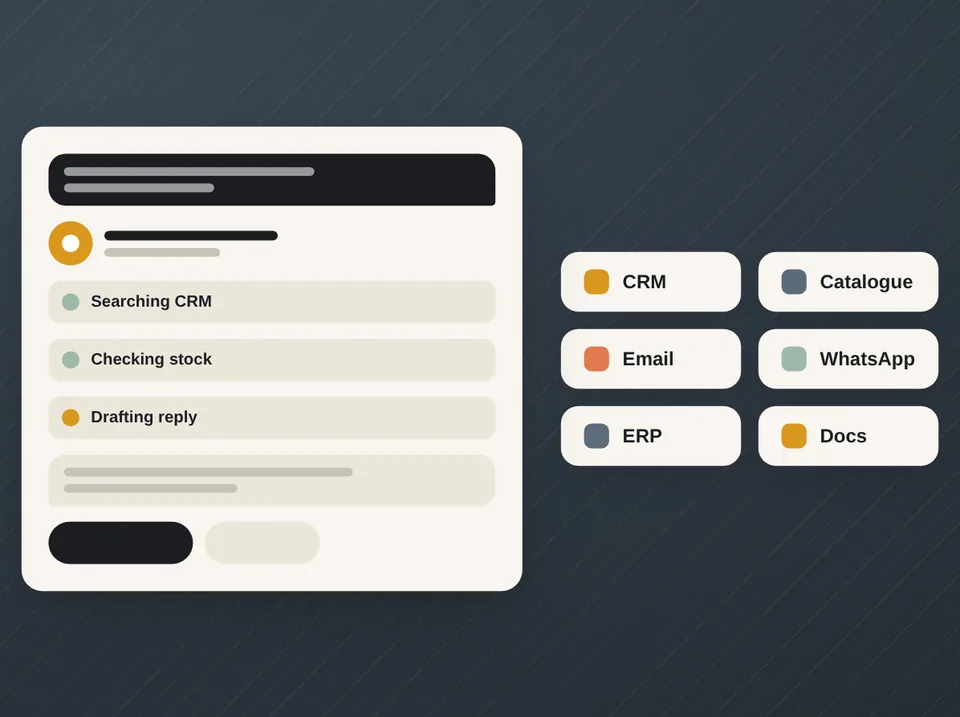 Service card · 4:3
AI Agent Development
Custom AI agents that take a goal, use your tools and finish the task — inside guardrails, approvals and logs.
Explore →