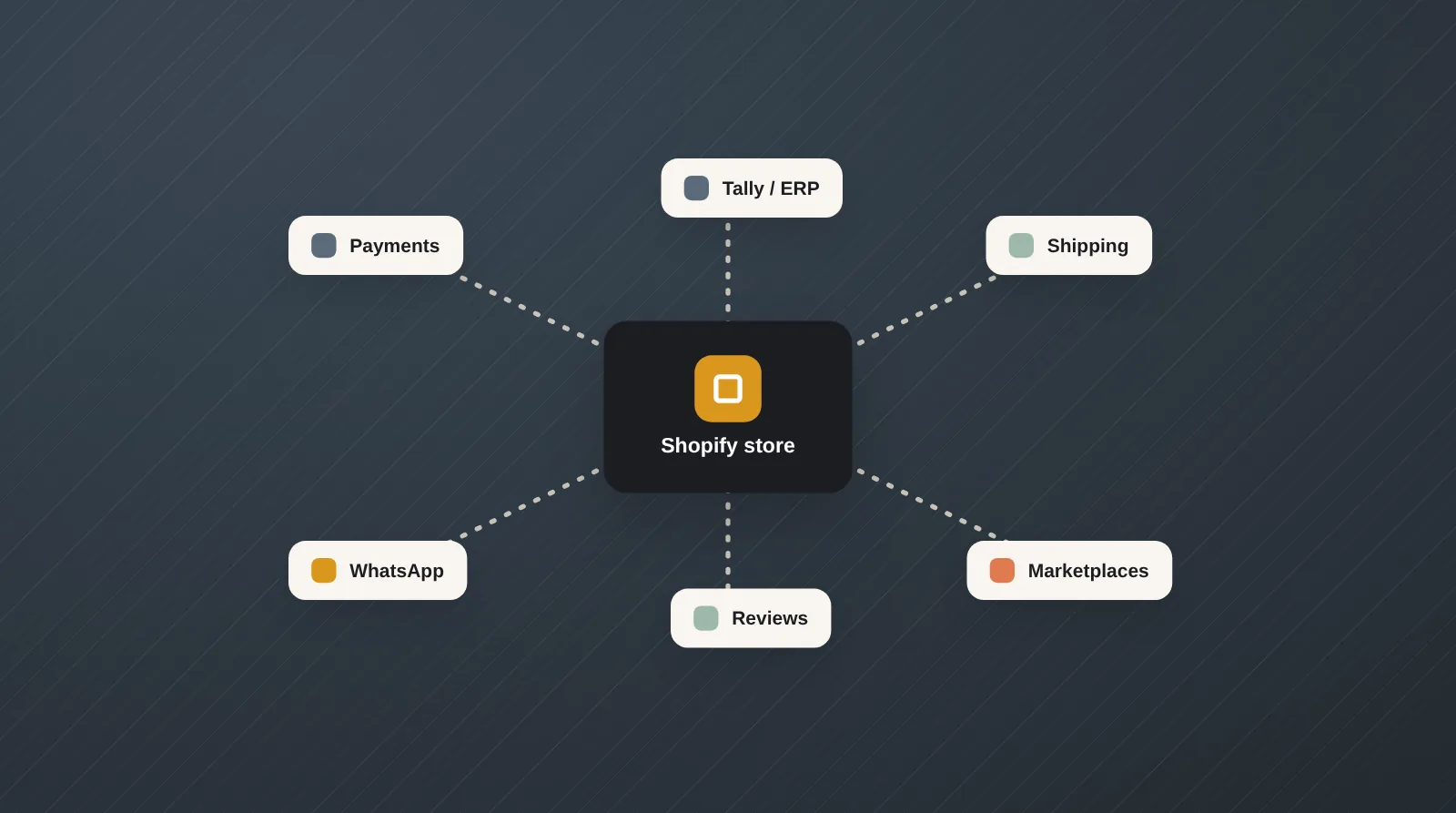
Indian Shopify brands need integrations in seven areas: payment gateways (Razorpay, PayU, Cashfree, CCAvenue, PhonePe), one-click checkout and COD verification (GoKwik, Shiprocket Checkout, Razorpay Magic Checkout), shipping (Shiprocket, Delhivery, Shipway, NimbusPost), WhatsApp (Interakt, WATI, AiSensy, Gallabox), GST invoicing and accounting (Tally, Zoho), marketplace sync, and tracking. Choose one tool per job, test it on a real order, and remove what you do not use.
Key takeaways
- Shopify Payments and Shop Pay are not generally available to Indian-registered stores, so start with an Indian gateway such as Razorpay, PayU, Cashfree, CCAvenue or PhonePe.
- One-click checkout can lift prepaid conversion and control COD, but it changes how discounts, tracking and reporting behave; pilot before switching.
- Use one shipping aggregator and one WhatsApp provider; overlapping tools double messages and costs.
- Sync Tally or Zoho and marketplaces through as few connection points as possible, with one named source of truth for stock.
- Every integration needs a clear job, an owner and a quarterly review.
Which integrations does an Indian Shopify store need?
An Indian Shopify store needs one tool in each of ten categories at most, and many stores need fewer. Use this table to map your stack and spot gaps or overlaps.
| Category | Common options | What to check |
|---|---|---|
| Payment gateway | Razorpay, PayU, Cashfree, CCAvenue, PhonePe | Rates by method, UPI success rate, settlement time, EMI and international cards |
| One-click checkout | GoKwik, Shiprocket Checkout, Razorpay Magic Checkout | Pricing model, COD controls, discount and bundle support, tracking events |
| COD verification | Checkout-provider RTO tools, WhatsApp confirmation flows | Confirmation rate, RTO reduction, effect on conversion |
| Shipping | Shiprocket, Delhivery, Shipway, NimbusPost | Pincode coverage, courier mix, NDR handling, COD remittance cycle |
| Interakt, WATI, AiSensy, Gallabox | Shopify triggers, template approvals, Meta message costs, team inbox | |
| GST invoicing | GST invoice apps, accounting software | GSTIN capture, HSN codes, place of supply, credit notes |
| Accounting and ERP | Tally connectors, Zoho Books, Zoho Inventory, Odoo, ERPNext | Sync direction and frequency, SKU and ledger mapping, returns |
| Marketplaces | Multichannel order and inventory systems | Amazon, Flipkart, Myntra and quick commerce coverage, stock buffers |
| Reviews and loyalty | Judge.me, Loox, Okendo, Nector, Smile.io | Speed impact, photo reviews, points on COD orders |
| Analytics and ads | GA4, Facebook & Instagram channel, Google & YouTube channel | Conversions API, deduplication, checkout events, consent |
Check what Shopify does natively before adding any of these; the best Shopify features guide lists the built-in tools.
Which payment gateway and one-click checkout should you use?
Start with one reliable Indian gateway on Shopify checkout, and add a one-click checkout only when data shows checkout friction or COD losses. Razorpay, PayU, Cashfree, CCAvenue and PhonePe all support UPI, cards, net banking and wallets; compare them on effective rates for your payment mix, UPI success rates, settlement speed, international card support and the quality of their Shopify integration. If you sell abroad from India, confirm which gateway accepts international cards and how foreign-currency payments settle; a brand registered in Canada or another Shopify Payments country can usually use Shopify Payments and Shop Pay instead.
One-click checkouts such as GoKwik, Shiprocket Checkout and Razorpay Magic Checkout replace or overlay Shopify’s checkout with phone-number login, saved addresses across their network, prepaid offers and COD rules. They can raise conversion for mobile-first buyers, but check four things first:
- Whether discounts, bundles and gift cards behave as they do on Shopify checkout.
- Whether purchase events reach Meta, Google and GA4 with values, once each.
- How orders, payment status and COD flags appear in Shopify and downstream tools.
- The effective cost per order at your prepaid and COD mix.
The Kitcoz store pairs GoKwik checkout with Meta Pixel and Conversions API tracking, a common setup for Indian D2C brands.
How do you handle COD verification and shipping?
Verify risky COD orders before dispatch and ship through one aggregator that covers your pincodes, because return-to-origin (RTO) on unverified COD orders is the largest avoidable cost in Indian D2C.
- COD verification: confirm orders above a set value or from high-RTO pincodes by automated WhatsApp message or call. One-click checkouts and shipping platforms offer RTO risk scores, and Shopify Flow can tag orders that need a check.
- COD rules: limit COD by order value or pincode, add a small COD fee, or offer a prepaid discount. COD vs prepaid explains the economics.
- Shipping aggregators: Shiprocket, Shipway and NimbusPost connect many couriers with rate comparison, labels and tracking; Delhivery can also be integrated directly. Judge them on pincode coverage, non-delivery report (NDR) workflows, COD remittance timelines and branded tracking pages.
- Pincode checker: show delivery estimates and COD availability on the product page, before checkout.
Which WhatsApp integration fits a Shopify store?
Choose a WhatsApp Business API provider with native Shopify triggers for orders, abandoned carts, COD confirmation and delivery updates; Interakt, WATI, AiSensy and Gallabox are common choices in India. Compare them on Shopify triggers, flow builder, shared team inbox, chatbot options, segmentation and support quality.
Costs have two parts: the provider’s subscription and Meta’s per-message charges, which vary by message category (marketing, utility, authentication) and by country. Roll out in this order:
- Order confirmation and shipping updates (utility templates).
- COD confirmation with one-tap confirm or cancel buttons.
- Abandoned cart and checkout recovery.
- Review requests timed to when the product has been used.
- Campaigns to segments, such as lapsed buyers or a festive list, rather than blasts to everyone.
For bots that answer product questions, see AI chatbots for website and WhatsApp.
How do you connect Shopify to GST invoicing, Tally, Zoho and marketplaces?
Connect accounting and marketplaces through as few sync points as possible, with Shopify or your ERP named as the single source of truth for stock.
- GST invoicing: Shopify’s default order confirmations are not full GST invoices. Use a GST invoice app, a customised Order Printer template or your accounting software to issue invoices with GSTIN, HSN codes, place of supply and the correct CGST, SGST or IGST split, and capture the buyer’s GSTIN for B2B orders. Businesses above the e-invoicing turnover threshold also need IRN generation for B2B invoices.
- Tally: connectors push Shopify orders, payments and returns into Tally as vouchers; check how they map SKUs, ledgers, gateway settlements and COD remittances.
- Zoho: Zoho Books and Zoho Inventory offer Shopify integrations for orders, items and stock.
- ERP: Odoo, ERPNext or a custom ERP connect through the Shopify Admin API; see custom ERP vs Odoo vs ERPNext vs Tally and our ERP development service.
- Marketplaces: a multichannel order and inventory system syncs stock and orders across Shopify, Amazon, Flipkart, Myntra and quick commerce, with buffers to prevent overselling. The Charliee engagement is an example of one team running a Shopify website alongside Amazon, Flipkart, Blinkit, Zepto and Instamart.
Which reviews, loyalty and tracking integrations are worth it?
Reviews and tracking are worth setting up at launch; loyalty is worth adding once repeat purchase is part of the model.
- Reviews: Judge.me, Loox, Okendo or Yotpo for photo and video reviews, review requests by email and WhatsApp, and star ratings in Google. Pick the one that loads lightest on mobile.
- Loyalty and referrals: Nector, Smile.io or similar. Decide whether COD orders earn points only after delivery, to avoid rewarding RTO.
- Analytics: GA4 through the Google & YouTube channel or a tag manager, with ecommerce events checked on a real order.
- Meta Conversions API: Shopify’s Facebook & Instagram channel sends server-side events at its higher data-sharing settings; third-party checkouts need their own Conversions API setup, deduplicated against the Pixel.
Tracking errors are the most expensive silent failure in a Shopify stack. Reconcile Shopify orders with Meta and Google purchases weekly, as described in the D2C ecommerce growth guide.
How do you choose Shopify integrations without bloating the store?
Give every integration one job, one owner and one review date. Rules that keep a store fast and affordable:
- Use native Shopify first (Search & Discovery, Flow, Bundles, Shopify Email, Inbox) and add an app only to fill a real gap.
- One tool per job: one primary gateway, one checkout, one shipping aggregator, one WhatsApp provider, one reviews app.
- Prefer apps that use theme app blocks and embeds, which remove cleanly, over apps that inject code.
- Test mobile speed before and after each install; the Shopify speed and conversion checklist shows how.
- Test each integration on real orders: prepaid, COD, discounted and returned.
- Review apps and bills every quarter and remove anything that has not earned its fee.
A sensible launch stack is one gateway, one shipping aggregator, one reviews app, a WhatsApp provider for order updates and COD confirmation, a GST invoice app, and the Facebook & Instagram and Google & YouTube channels. Add a one-click checkout, loyalty, Tally or ERP sync and a marketplace order system in the growth stack, once order volume or a measured problem justifies each one.
gaa-tha sets up and maintains these stacks through Shopify development and Shopify store management, and builds custom connectors or AI workflow automation where no app fits.
Frequently asked questions
There is no single best gateway: Razorpay, PayU, Cashfree, CCAvenue and PhonePe all integrate with Shopify and support UPI, cards and net banking. Choose on effective rates for your payment mix, UPI success rates, settlement speed and support, and renegotiate as volume grows.
All three offer one-click login, address prefill and COD controls, so the right one depends on pricing at your order mix, RTO features, compatibility with your discounts and bundles, and how cleanly it sends tracking events. Pilot one and compare conversion and RTO against Shopify checkout before committing.
Yes, through third-party connectors that push orders, payments and returns into Tally. Check ledger and SKU mapping and how gateway settlements and COD remittances are recorded; larger businesses often route Shopify through an ERP or order management system instead.
Shopify’s default order confirmations are not full GST invoices. Use a GST invoice app, a customised Order Printer template or your accounting software to issue invoices with GSTIN, HSN codes and the correct tax split.
As few as the business genuinely needs; there is no fixed number. What matters is that each app has a clear job, is used, and does not slow the mobile storefront, so review the list every quarter.
Shopify Payments and Shop Pay are not generally available to Indian-registered stores. Indian stores use third-party gateways such as Razorpay, PayU, Cashfree, CCAvenue or PhonePe, often alongside a one-click checkout.
Want this done for you?
gaa-tha builds the strategy, the creative and the commerce operations — for brands across India and beyond.
Start a project →